Legacy example · C++ · Version 1.0
VPI Stereo Vision
| Authors | Holoscan Team (NVIDIA) |
|---|---|
| Supported platforms | x86_64, aarch64 |
| Language | C++ |
| Version | 1.0 |
| Compatibility | HSDK 3.11 |
| Contribution level | Level 1 · Very high-quality code |
| Source | HoloHub |
Legacy HoloHub application
This application comes from HoloHub and was last tested with Holoscan SDK (HSDK) 3.11. It runs with the HoloHub CLI, ./holohub.
Overview
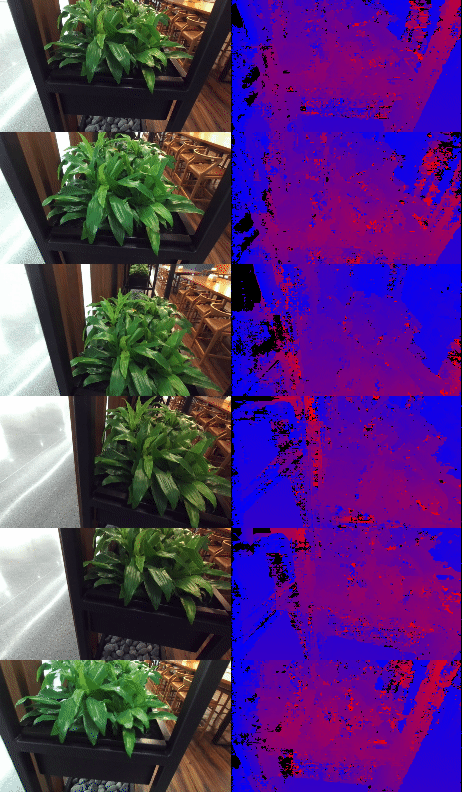
Demo pipeline showing stereo disparity estimation using the Vision Programming Interface VPI.
Description
This pipeline takes video from a stereo camera and uses VPI's stereo disparity estimation algorithm. The input video and estimate disparity map are displayed using Holoviz.
The application will select accelerator backends if available (OFA, PVA and VIC). This demonstrates how VPI can be used to offload stereo disparity processing from the GPU on supported devices such as NVIDIA IGX, AGX, or NX platforms.
Input Video
Requires a V4L2 stereo camera, or recorded stereo video, and matching calibration data. By default, the application will share the same source data as stereo_vision.
Requirements
This demo requires VPI version 3.2 or greater. The included Dockerfile will install VPI and its dependencies for either an amd64 target (with discrete NVIDIA GPU), or arm64 target (NVIDIA IGX, AGX, or NX).
Build and Run Instructions
Using default video source (same as stereo_vision application):
./holohub run vpi_stereo
Using a v4l2 video source (live camera or loopback device):
./holohub run vpi_stereo --run-args="--source v4l2"