Software-defined
ultrasound
Run beamforming, reconstruction, AI, and transmit-control algorithms on the GPU. Stream raw echoes into GPU memory with Holoscan Sensor Bridge (HSB), then use the results to steer the next shot.
Collect raw data for AI research, or use the design as the starting point for a prototype ultrasound device. Build on the same acquisition, GPU processing, and transmit-control pipeline.
Available nowAnnounced at GTC Berlin · HSB-based Ethernet
Apache 2.0 Licensed Open SourceFPGA design and host code you can inspect, modify, and extend
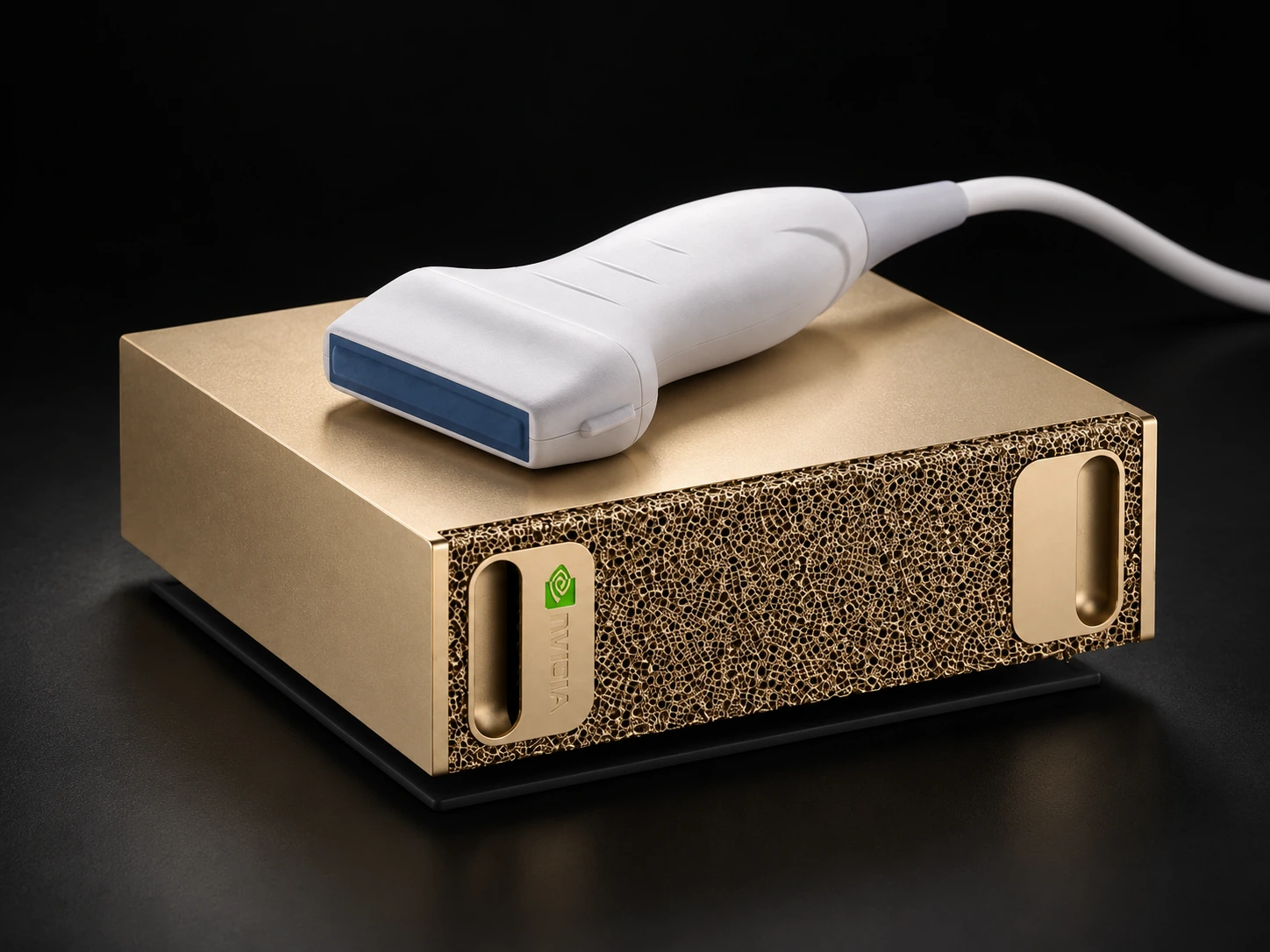
The reference design in action
- Transmit / receive channels
- 128 TX / 64 RX
- TI ultrasound analog front end
- Sustained raw RF streaming
- 12.1 Gb/s
- Reported at 30 frames/s
- Shot-to-shot transmit updates
- ~1,500 /s
- 24 frames/s × 64 shots = 1,536 updates/s
Results reported for the IUS 2026 demo configuration. Streaming and transmit-update figures describe separate operating points.
Develop at the
speed of software
Keep your algorithms in GPU software. Use coding agents to develop kernels, build tests, and explore new approaches to beamforming, reconstruction, and acquisition control.
The FPGA handles capture, timing, and transport. High-bandwidth Ethernet gives your GPU access to the raw channels, so you can change an algorithm and test it without rebuilding FPGA logic for every experiment.
Develop with coding agents
Start from the open demonstration pipeline. Have an agent help write a CUDA kernel, adapt an operator, or create a test against your reference result.
Test on the GPU
Replay captured channel data to compare image quality and throughput. Profile latency, refine the algorithm, and repeat.
Close the acquisition loop
Connect your algorithm to live receive data and programmable transmit. Evaluate its decisions on the next acquisition cycle.
The hardware
behind the loop
A linear array probe connects to TI acquisition electronics, a Terasic Holoscan Sensor Bridge board, and NVIDIA accelerated computing. Ethernet carries raw measurements to the host and transmit settings back to the sensor.
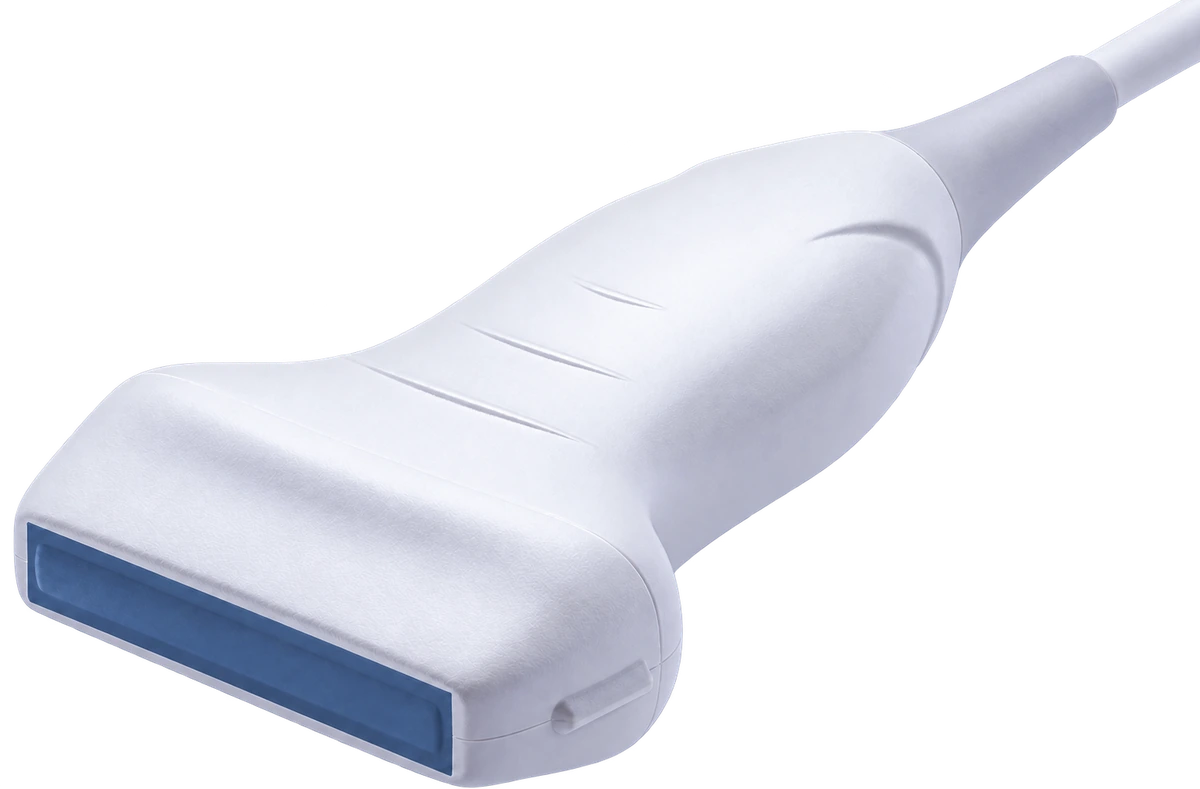
Linear array probe
The Sonsoray probe transmits ultrasound pulses and receives echoes from the field of view.
Plane-wave and focused imaging are implemented in the project.
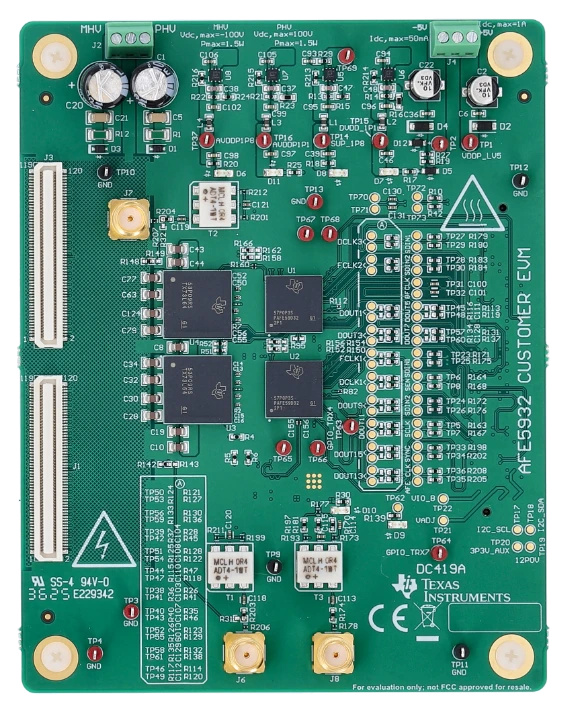
TI ultrasound AFE EVM
128 transmit and 64 receive channels, with two AFE5932 receivers and two TX73L64 transmitters.
LVDS carries receive data. SPI programs transmit settings.
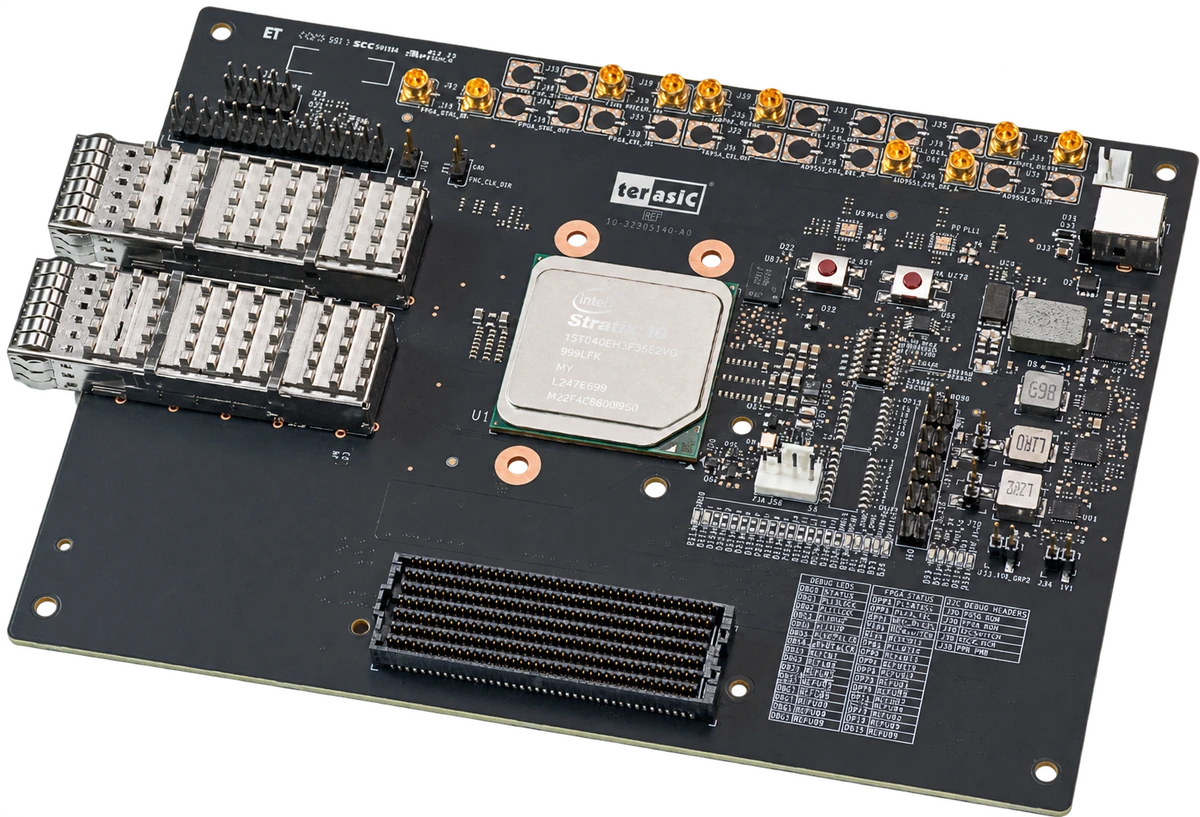
Terasic HSB 100G
An Altera Stratix 10 TX FPGA handles capture, timing, transmit-update parsing, and HSB transport.
Two 100 GbE ports. One interface is active at a time in this design.
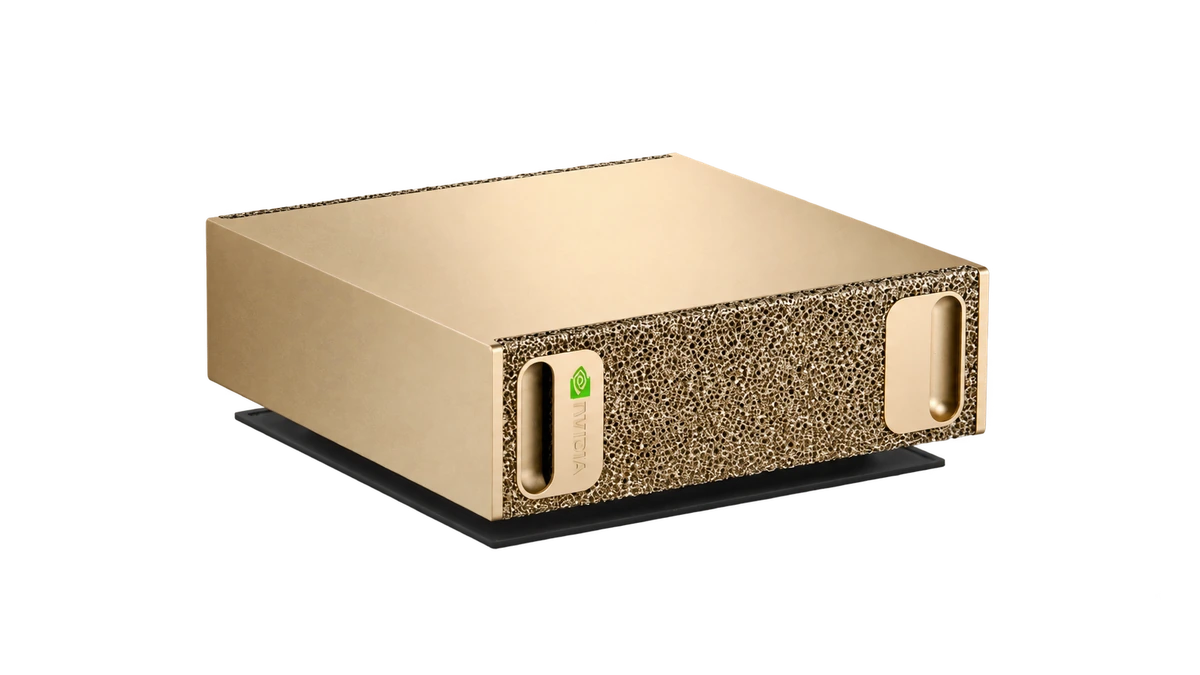
NVIDIA DGX Spark
NVIDIA GB10 Grace Blackwell compute brings GPU reconstruction and acquisition control to the desktop.
The reference design also runs on the IGX Thor T7000 Developer Kit.
Receive data
Raw RF into GPU memory
- Probe echoesAnalog receive
- TI receiversLVDS channel data
- Holoscan Sensor Bridge100 GbE / GPUDirect RDMA
- GPU memoryBeamform, reconstruct, interpret
Transmit control
Software changes the next shot
- GPU or hostCompute transmit settings
- Holoscan Sensor BridgeReceive updates over Ethernet
- TI transmittersApply settings over SPI
- Next probe pulseAcquire new echoes
The host schedules each send and shot. The receive front end produces up to 38.4 Gb/s instantaneous RF payload from 64 channels × 12 bits × 50 MSPS; sustained streaming in the demo is 12.1 Gb/s.
Put the GPU
in the transmit loop
Ultra-low-latency raw-data transport connects GPU processing to acquisition control. Holoscan brings perception and control into one runtime, from incoming echoes to the next transmit decision.
Demonstrated capabilities
- Live GPU beamforming and B-mode display
- Optional MimickNet image enhancement on the GPU
- Continuous raw-channel streaming and RF capture
- GPU- or host-computed transmit updates, shot-to-shot
Your adaptive beamformer
Replace the demonstration beamformer with your own GPU algorithm. Use the received channel data to compute new steering or focusing parameters and send transmit updates back through Sensor Bridge, cycle by cycle.
Extend that feedback path with a model that selects the next region of interest or acquisition sequence. The host schedules each send and shot; your algorithm supplies the decision.
The Holoscan execution foundation
Bring the feedback loop into one application graph and tune its execution for your target system.
GPUDirect RDMA
Stream raw receive data from Sensor Bridge into GPU memory without an intermediate CPU copy.
CUDA Graphs
Replay eligible GPU processing stages with one launch, reducing repeated CPU dispatch and kernel-launch overhead.
Pinned CPU cores
Bind runtime threads to chosen CPU cores to control placement and reduce thread migration in the acquisition and control path.
CUDA green contexts
Assign GPU streaming multiprocessor sets to execution partitions on supported targets.
Developer previewFor research labs
and device developers
A working demonstration pipeline, with the source to take it further. Get the Apache 2.0 licensed FPGA design and host code, plus a component shopping list and setup guide.
Inspect the implementation. Replace the beamformer. Add a model or change the acquisition sequence. This permissively licensed reference design is built to be modified and extended into your own instrument.
Academic researchers
Use the reference design in your lab to collect raw ultrasound channel data. Build datasets to train and evaluate AI algorithms, and compare reconstruction approaches using your own captured signals.
Medical-device developers
Use the working acquisition, GPU processing, and transmit-control paths as a launchpad for your prototype ultrasound device. Adapt the hardware and integrate your own beamforming, image enhancement, or on-device AI.
Explore the building blocks
Algorithm developers can also start with existing channel datasets, including OpenH-RF, then bring trained models into a live Holoscan pipeline. Explore the data, software examples, and hardware-integration guides below.
GPU beamforming
Explore an ultrasound beamforming example built with MATLAB GPU Coder and Holoscan.
Ultrasound processing
Explore configurable postprocessing stages and GPU-accelerated ultrasound image processing.
Sensor Bridge guides
Understand the transport architecture, host setup, and sensor integration.
OpenH-RF data
Explore openly available ultrasound channel captures for reconstruction research and evaluation.