Legacy example · Python · Version 1.0
Polyp Detection
| Authors | Holoscan Team (NVIDIA) |
|---|---|
| Supported platforms | x86_64, aarch64 |
| Language | Python |
| Version | 1.0 |
| Compatibility | HSDK 3.3 |
| Contribution level | Level 2 · Quality code |
| Source | HoloHub |
Legacy HoloHub application
This application comes from HoloHub and was last tested with Holoscan SDK (HSDK) 3.3. It runs with the HoloHub CLI, ./holohub.
This application demonstrates how to run polyp detection models on live video in real-time.
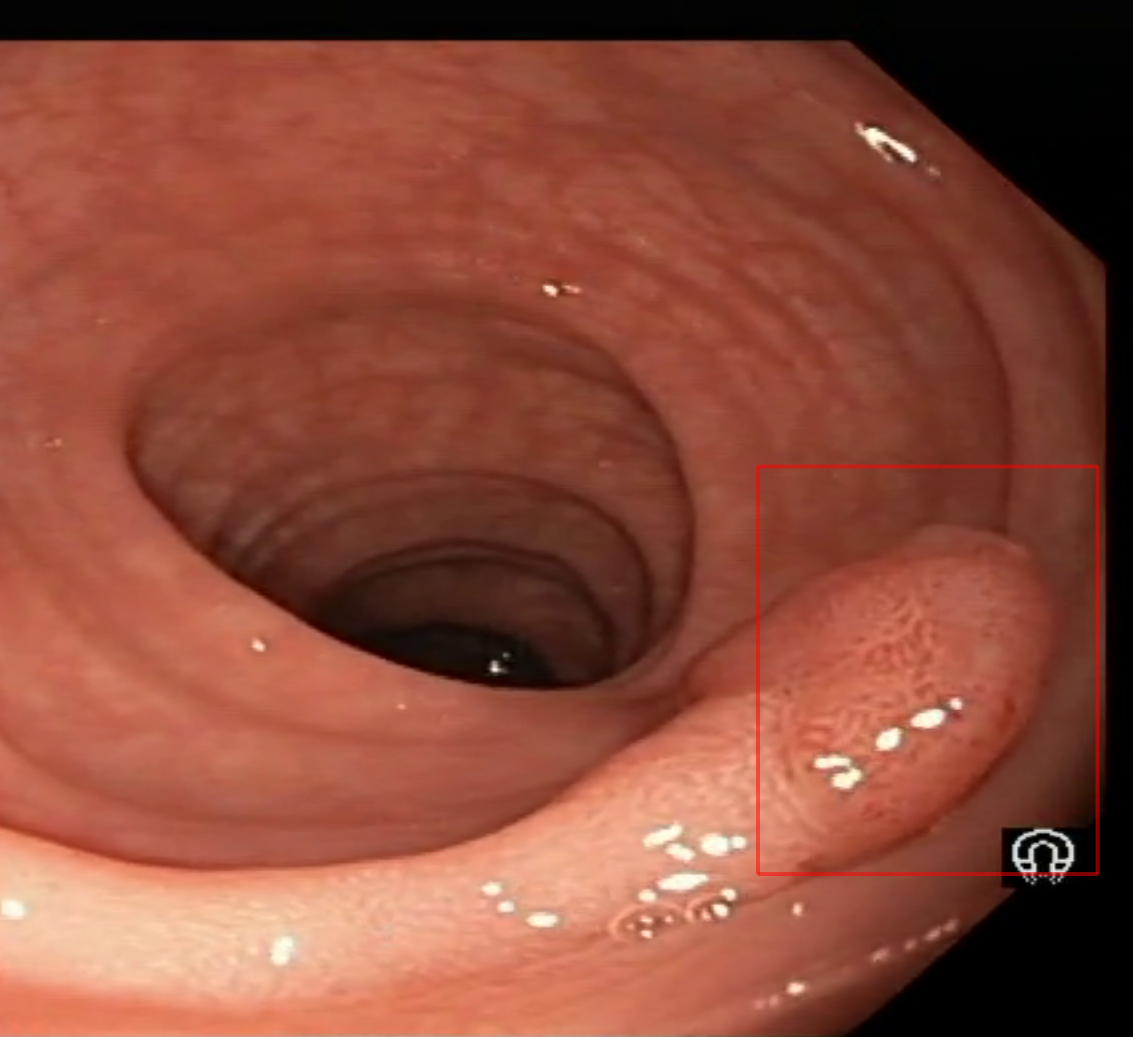
The model: RT-DETR v2 is trained on the REAL-Colon dataset.
Compared to the SSD object detection model described in the paper, RT-DETR demonstrates improvements. The table below shows metrics for SSD obtained from Table 3 of the paper, and metrics for RT-DETR calculated on the same test set (using all test images from the REAL-Colon dataset).
| Method | MAP@0.5 | MAP@0.5:0.95 |
|---|---|---|
| SSD | 0.338 | 0.216 |
| RT-DETR | 0.452 | 0.301 |
Run Instructions
For simplicity a DockerFile is available. To run this application:
./holohub run polyp_detection
The (NGC) Sample App Model for AI Polyp Detection and the (NGC) Sample App Data are automatically downloaded and converted to the correct format when first run the application.
If you want to manually convert the video data, please refer to the instructions for using the convert_video_to_gxf_entities script.
If you want to run the polyp_detection.py script directly with the built docker container, please refer to the following instructions:
- Ensure that the
rtdetrv2_timm_r50_nvimagenet_pretrained_neg_finetune_bhwc.onnxfile is located in the directory specified by thedataargument. - Verify that the generated video files (
.gxf_indexand.gxf_entitiesfiles) are in the directory specified by thevideo_dirargument. - Specify the correct video width and height using the
video_sizeargument.
For example:
python polyp_detection.py --data /path-to-onnx-model/ --video_dir /path-to-video/ --video_size "(width, height)"